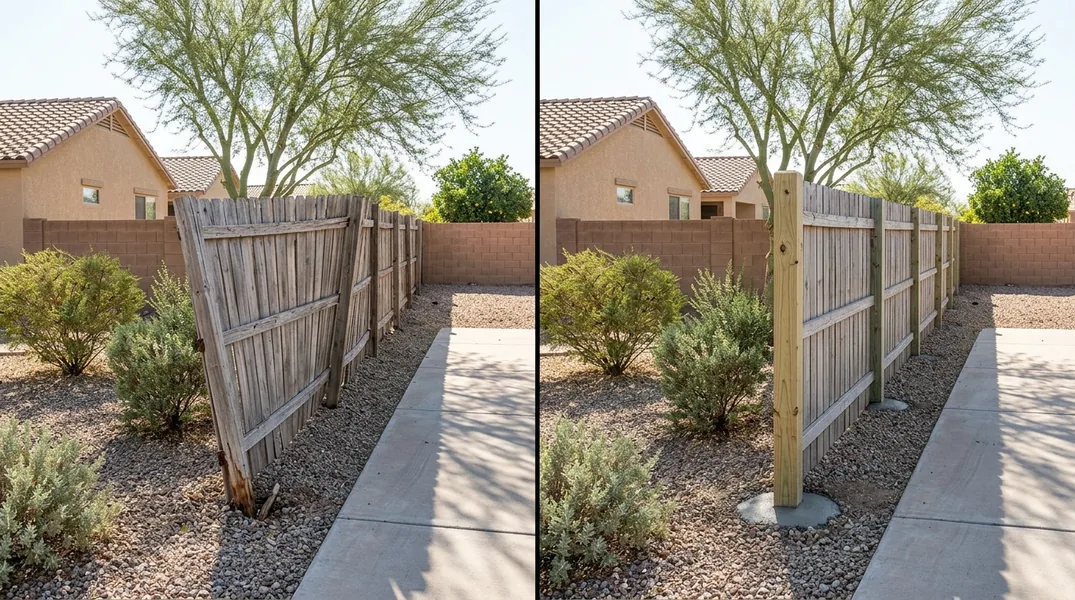
The Chandler Climate and Soil Challenge
If you own a home in Chandler, you've likely noticed something peculiar about fences in the area. Many lean slightly, tilt unexpectedly, or develop visible gaps between posts and panels. This isn't a sign of poor installation alone. Rather, it's the result of three interconnected environmental factors unique to the Arizona desert: caliche hardpan, flood irrigation practices, and the natural lifecycle of wood fence posts buried in our challenging soil.
Caliche is a naturally occurring layer of calcium carbonate that forms in arid climates like ours. This rock-hard substance sits just beneath the surface of Chandler soil, sometimes only 12 to 18 inches down. When fence contractors dig post holes, they often hit this impenetrable layer, which forces them to either drill through it, work around it, or set posts at shallower depths than ideal. A post that isn't set deep enough lacks the lateral support it needs to stay perfectly plumb year after year.
How Flood Irrigation Destabilizes Fence Posts
Many properties in Chandler rely on flood irrigation for landscaping, especially those with mature trees and shrubs. While this method is efficient for watering large areas, it creates a hidden problem for fence posts. When water floods the ground around a fence line, it saturates the soil and softens the base where posts sit. Over time, this repeated saturation weakens the compacted soil that holds posts upright, allowing them to shift and settle unevenly.
The problem compounds because water doesn't drain uniformly across caliche hardpan. Instead of percolating straight down, water pools and moves laterally along the caliche layer, lingering near post bases for extended periods. This prolonged moisture exposure accelerates wood rot, concrete deterioration, and the loss of bearing strength. A post that was stable for five years may begin to lean noticeably in year six or seven as the soil underneath loses its grip.
Rotted Post Bases: The Silent Culprit Behind Leaning Fences
Wood rot at the base of fence posts is perhaps the most common reason fences lean in our region. Even pressure-treated lumber, which resists rot better than untreated wood, eventually succumbs to prolonged contact with wet soil. The wood fibers soften, lose their structural integrity, and can no longer support the weight of the fence panels and the lateral forces from wind.
When a post base rots, the damage often goes unnoticed until the fence visibly leans. By then, the post may have lost 30 to 50 percent of its structural capacity. This is why Wood & Privacy Fence Installation in Chandler requires attention to drainage and post protection from the start. Posts should be set in concrete that slopes away from the base to shed water, and ideally, they should be elevated slightly above grade to allow air circulation and faster drying after irrigation or rain.
Leaning Fence Repair Near Me: When to Call a Professional
If you notice your fence leaning, sagging, or developing gaps, the first step is to determine whether the problem is cosmetic or structural. A slight lean might be acceptable if the fence is still secure and the posts are solid. However, if you can push on the fence and feel movement, or if the lean is getting worse year after year, structural failure is likely underway and repair is urgent.
Minor leans sometimes respond to post reset and re-bracing, where a contractor straightens the post, re-sets it in concrete, and adds temporary braces while the concrete cures. This approach works best when the post wood itself is still sound and the lean is recent. However, if the post base is rotted, simply resetting it won't solve the problem. In those cases, contact Chandler Fence Company for a professional assessment. We serve the greater Chandler area and can evaluate whether repair or replacement is the better solution.
Fence Post Replacement: When Repair Isn't Enough
Sometimes a leaning fence requires more than a simple reset. If the post wood is soft, discolored, or crumbles when probed, the post needs replacement. Fence post replacement involves removing the damaged post, excavating around it, and setting a new post in concrete with proper slope and drainage. This is more labor-intensive than a reset, but it addresses the root cause and restores the fence to like-new condition.
When replacing posts, Chandler Fence Company uses pressure-treated lumber rated for ground contact and ensures posts are set deep enough to resist wind and lateral forces. We also pay special attention to concrete installation, sloping it away from the post base and using quality concrete mix that resists the alkali content of our local soil. The result is a post that will remain plumb and stable for another 15 to 20 years, even in Chandler's challenging environment.
Prevention: How to Keep Your Fence Straight
The best approach to leaning fences is prevention. If you're planning a new Wood & Privacy Fence Installation, work with a contractor who understands caliche and local soil conditions. Posts should be set at least 30 inches deep (deeper in areas with shallow caliche), and concrete should be properly sloped and finished above grade. Avoid setting posts directly in soil without concrete, as this dramatically shortens the post's lifespan in our climate.
For existing fences, manage irrigation carefully. Direct water away from fence lines when possible, and if you must flood irrigate, do so during cooler months when evaporation is slower and standing water is less likely. If your fence is already leaning, don't wait. The longer a post leans, the more stress it places on adjacent posts and fasteners. Call Chandler Fence Company at (623) 600-7122 or request a free estimate to discuss your options. We'll assess the damage, explain what caused it, and recommend the most cost-effective repair or replacement strategy for your property.
Looking for a professional fence contractor in Chandler? Chandler Fence Company responds fast for all your fence needs.
Get a Free Quote