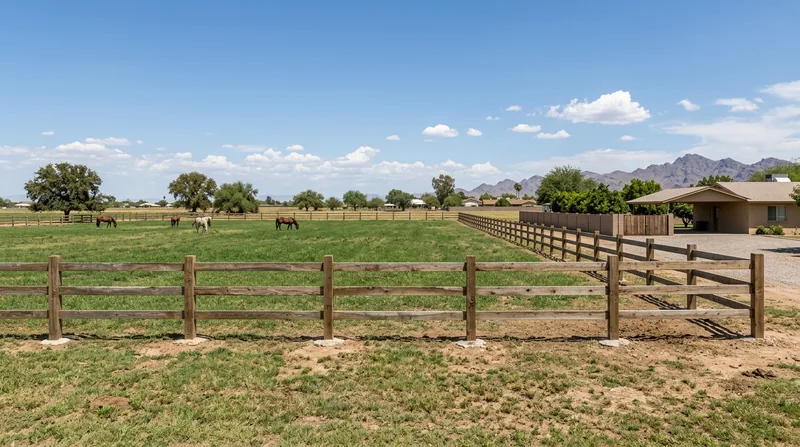




Farm fence installation in Chandler means building durable perimeter and internal divisions across acreage where block walls and residential privacy fencing do not fit the workload. Desert properties in and around Chandler often run 2 to 10 acres or more, and the terrain here, caliche hardpan, relentless UV, and sparse vegetation, demands materials and methods built for long runs, livestock containment, and equipment access. Split rail, no-climb horse fence, field wire, and pipe fencing are the working stock on ranch and agricultural land across Greater Chandler. We install straight lines over long distances, brace corners against wind, set posts in concrete to fight the dry desert climate, and build gates sized for trailers and machinery. Whether you are fencing pasture, securing a perimeter, or dividing grazing land, the goal is a fence that holds its line and function for years under Arizona sun and the occasional monsoon wind.
Why Farm & Ranch Fencing Matters in Chandler Desert Properties
Chandler and the surrounding desert communities sit on low-density acreage where traditional residential fencing does not serve agricultural or large-property needs. Block walls dominate neighborhood perimeters, but ranch land, horse properties, and working acreage require open-line fencing that allows sight lines, water flow, and equipment movement while containing livestock and marking boundaries. The Chandler climate accelerates the wear on untreated wood and fades powder coating faster than humidity ever would, so material choice and installation depth matter more here than in wetter regions. Posts set in concrete, galvanized hardware, and pressure-treated lumber are not optional upgrades, they are the baseline for a fence that stays true.
- Split rail and no-climb horse fence contain livestock safely while maintaining open sight lines across pasture.
- Pipe fencing offers strength and longevity for high-traffic areas and gates that carry heavy equipment.
- Field wire and wire-and-rail combinations provide economical perimeter security without blocking views or water flow.
- Caliche hardpan in the Chandler area requires proper post-hole depth and concrete setting to prevent frost heave and dry-season settling.
- Long runs and corner bracing distribute wind load and hold the fence line true under monsoon microbursts.
A properly built ranch fence on Chandler acreage holds its function and appearance for 15 to 20 years with routine maintenance, and the upfront investment in depth, concrete, and galvanized hardware pays back in years without sagging or leaning.
Key info: Caliche in Chandler and surrounding areas is a cemented hardpan that makes post holes slow and sometimes requires an auger or jackhammer. Budget extra time and equipment for post setting, and always call 811 before digging to locate buried utilities. Arizona law requires a utility locate before any digging begins, and it is free.
For detailed guidance on permits and property line verification, consult the Chandler Building Safety and Development Services office, which sets height, setback, and material standards for your specific zone.
How We Install Farm & Ranch Fencing in Chandler: A Straightforward Process
Farm and ranch fencing on acreage requires a different approach than residential privacy fence installation. We start with a site walk to understand terrain, identify obstacles, and verify property lines from your existing survey or deed description. We then establish the fence line, mark post locations at standard intervals (typically 6 to 8 feet for rail, 4 to 6 feet for wire), and prepare the ground. Caliche removal, post holes dug to proper depth, concrete setting, and careful alignment ensure the fence holds its line and resists the wind and sun exposure that define the Chandler climate.
- Verify the fence line from your property survey and mark post locations with care to avoid buried utilities and natural obstacles.
- Dig post holes to frost-safe depth (typically 30 to 36 inches in the Chandler area) and remove caliche where necessary.
- Set posts in concrete rather than tamped soil to resist settling and heave in the desert climate.
- Install rails, wire, or pipe in straight lines, using anti-sag bracing at corners and long runs to hold the fence true.
- Hang gates on heavy-duty hinges, sized and braced for the weight of equipment and livestock traffic.
- Inspect the entire line for alignment, tension, and hardware security before final sign-off.
The entire process, from survey verification to final gate hanging, ensures a fence that works as hard as your property demands.
Local example: A 5-acre horse property in San Tan Valley with a 1,200-foot perimeter typically takes 4 to 6 working days for no-climb horse fence installation, including post holes dug through caliche, concrete setting, rail installation, and a gated entrance. A property in Queen Creek with internal pasture divisions may require additional line runs and bracing, extending the timeline to 7 to 10 days.
For more on our installation standards and materials, see our wood fence installation page and gate installation and repair services.
Farm & Ranch Fencing Methods and Materials for Desert Acreage
| Approach | Description | Best for |
|---|---|---|
| Split Rail Fence | Horizontal rails set into post mortises, pressure-treated or cedar, spaced 6 to 8 feet apart, no wire or mesh. | Perimeter definition, horse properties, aesthetic appeal, and properties where open sight lines matter. |
| No-Climb Horse Fence | Horizontal rails with vertical mesh or rigid grids, preventing hooves from catching and horses from climbing out. | Equestrian properties, paddocks, and pastures where livestock safety and containment are non-negotiable. |
| Pipe Fencing | Steel pipe set in concrete, galvanized or powder-coated, horizontal or vertical, heavy-duty and long-lasting. | High-traffic gates, equipment yards, perimeter security, and areas exposed to wind and UV stress. |
| Field Wire and Wire-and-Rail Combinations | Woven or barbed wire attached to wooden or steel posts, economical and flexible for long perimeters and internal divisions. | Cattle ranches, large acreage, and properties where perimeter marking and basic containment suffice. |
| Racked and Stepped Installation | Rails or pipe adjusted to follow sloped terrain, maintaining fence height and structural integrity on uneven ground. | Chandler and Queen Creek properties with slopes, washes, or rolling desert terrain where level installation is not possible. |
Each approach balances durability, cost, and function. Pressure-treated wood resists UV fade longer than cedar in the Chandler climate, and galvanized hardware outlasts powder coating on long-term exposure. We recommend concrete-set posts over tamped soil in the desert because the dry climate and lack of frost heave allow shallow tamping to work loose over years.
Farm & Ranch Fencing Cost in Chandler: What to Expect
Farm fence installation in Chandler pricing depends on material, length, terrain, and site access. A basic split rail or field wire fence on flat, clear acreage starts at $12 to $18 per linear foot installed, while no-climb horse fence and pipe fencing typically run $18 to $35 per linear foot due to heavier materials and labor. A 1,200-foot perimeter split rail fence on a 5-acre property in San Tan Valley might cost $14,400 to $21,600 installed, while a quarter-mile of no-climb horse fence could reach $28,000 to $42,000. Caliche removal, long post-hole drilling, and site access challenges add cost; internal divisions and multiple gates increase the scope and timeline.
Factors that move the price up include difficult ground (caliche requiring an auger or jackhammer), terrain slopes requiring racked or stepped installation, long distances from road access, and custom gate sizing for equipment traffic. We recommend getting 2 to 3 estimates from local installers and asking each one to itemize post depth, concrete volume, material grade, and labor hours so you understand where the cost lies.
For a detailed breakdown of our pricing structure and to discuss your specific property, visit our pricing page or call us at (623) 600-7122 for a free, no-obligation estimate. We respond within 24 hours.
Farm & Ranch Fencing Near Me: What Chandler Homeowners Should Know Before Hiring
Hiring a fence contractor for acreage work requires more than a price quote. Start by confirming that the installer carries general liability and workers' compensation insurance; ask for a certificate of insurance naming you as an additional insured. In Arizona, fence installation is regulated work: projects involving labor and materials above $1,000, or any job requiring a building permit, must be performed by a contractor holding an Arizona Registrar of Contractors (ROC) license in the Fencing classification (R-14). This is state law, not a company claim, and it protects you by ensuring the contractor carries surety bonding and meets training standards. Always verify the ROC license number on the Arizona ROC website before signing a contract.
Second, ask the contractor to work from your existing property survey or deed description to identify the fence line. Do not ask them to determine the boundary, that is the regulated work of a licensed land surveyor. Third, check whether a building permit is required in your jurisdiction; Chandler, Queen Creek, San Tan Valley, and other communities in the area have different rules, and an HOA or deed restriction may impose height, material, or color limits that override local code. The contractor should know the local rules, but it is your responsibility to verify setback and height requirements with the city or county before work begins.
- Confirm the contractor carries general liability and workers' compensation insurance and can provide a certificate of insurance on request.
- Verify the Arizona ROC license number on the state contractor board website before hiring.
- Request a written estimate that itemizes post depth, concrete volume, materials, and labor hours so costs are transparent.
- Ask for references from recent ranch or acreage projects in Chandler, Queen Creek, or San Tan Valley, and follow up with at least two.
- Confirm that the contractor will call 811 before digging and will verify the fence line from your survey rather than guessing the boundary.
- Check whether your HOA or deed restrictions limit fence height, material, or color, and ensure the design complies before work begins.
A contractor who takes time to understand your property, explains material choices clearly, and puts estimates in writing is the one to trust with a long-term investment like farm or ranch fencing.
Ready to get started? Contact us today for a free estimate and to discuss your acreage fencing needs.
Farm & Ranch Fencing in Chandler: Pricing Guide
| Service | Price | Details |
|---|---|---|
| Split Rail Fence | Starting at $12/ft | Pressure-treated or cedar rails set in concrete posts, open perimeter fencing, cost varies with post spacing and terrain |
| No-Climb Horse Fence | Starting at $18/ft | Rails with vertical mesh or grids, prevents livestock escape, higher material and labor cost than basic rail |
| Pipe Fencing | Starting at $22/ft | Steel pipe galvanized or powder-coated, set in concrete, durable for gates and high-stress areas, heavier material increases cost |
| Field Wire and Wire-and-Rail Combinations | Starting at $8/ft | Economical perimeter and internal divisions, cost depends on wire gauge, mesh size, and post spacing across long runs |
| Caliche Removal and Difficult Ground | On estimate | Chandler and surrounding desert hardpan requires auger or jackhammer work, adds significant labor and equipment time |
| Free Estimate | No obligation | Response within 24 hours at (623) 600-7122, includes site walk, line verification, and detailed written proposal |
Indicative pricing, the exact cost depends on square footage, finish, and site access. Free personalized estimate within 24h at (623) 600-7122.


